
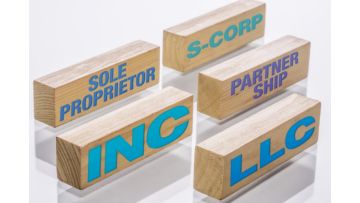
Entity selection remains one of the most valuable advisory services available to tax professionals. With the continued impact of the Qualified Business Income (QBI) deduction, the 21% corporate tax rate, evolving reasonable compensation standards, and growing interest in Qualified Small Business Stock (QSBS), entity planning has become increasingly complex.
This advanced course examines the tax consequences, planning opportunities, and compliance considerations associated with sole proprietorships, partnerships, LLCs, S corporations, and C corporations. Through detailed case studies and numerical comparisons, participants will evaluate how entity choice affects self-employment taxes, payroll taxes, retirement contributions, basis calculations, pass-through deductions, shareholder benefits, and long-term business growth strategies.
The course also reviews recent court cases involving assignment-of-income issues, management company structures, and shareholder compensation, providing practical insight into areas frequently challenged by the IRS.
Learning Objectives
Upon completion of this course, participants will be able to:
• Analyze tax consequences associated with sole proprietorships, partnerships, S corporations, and C corporations
• Evaluate the interaction between QBI deductions and entity selection planning
• Apply reasonable compensation principles to S corporation planning scenarios
• Assess partnership basis, loss limitation, and distribution considerations
• Recognize assignment-of-income and management company risks highlighted in recent court decisions
• Evaluate Qualified Small Business Stock (QSBS) opportunities and limitations
• Develop entity planning recommendations based on client-specific tax and business objectives
This course counts for 2 Hours of Federal Tax Law for IRS Continuing Education.
Frequently Asked Questions
Is an LLC or an S corporation better for taxes?
There is no one-size-fits-all answer. The best choice depends on income level, self-employment tax exposure, payroll requirements, QBI deductions, administrative costs, and long-term business goals.
What are the most common entity selection mistakes?
Common mistakes include assuming LLCs automatically reduce taxes, failing to consider QBI deductions, overlooking reasonable compensation requirements, and selecting an entity without evaluating long-term business objectives.
How does entity selection impact advanced tax planning?
Entity selection affects self-employment taxes, payroll taxes, basis calculations, QBI deductions, retirement planning, shareholder benefits, and long-term exit strategies.
What is reasonable compensation for an S corporation shareholder?
Reasonable compensation is based on factors such as duties performed, industry standards, experience, and time devoted to the business. There is no IRS-approved formula.
What is the assignment-of-income doctrine?
The assignment-of-income doctrine generally prevents taxpayers from shifting income to another entity when they personally earned the income.
What is Qualified Small Business Stock (QSBS)?
QSBS is a special tax provision that may allow qualifying C corporation shareholders to exclude a portion or all of their gain when selling stock, subject to statutory requirements.
Can partnership debt increase a partner's basis?
Yes. One advantage of partnership taxation is that partnership debt can increase a partner's basis under certain circumstances.
Are management company structures still viable?
Potentially, but they require careful planning, economic substance, proper documentation, and legal review to withstand IRS scrutiny.
Why should tax professionals coordinate with attorneys during entity planning?
Entity selection involves both tax and legal considerations, including liability protection, operating agreements, ownership structures, and compliance requirements.
Will this course discuss recent tax court cases?
Yes. The course reviews real-world cases involving reasonable compensation, assignment of income, and management company structures.bout the presenter:
Jason Dinesen (EA, LPA) is a tax nerd, entrepreneur, tax expert, and a well-known presenter of continuing education courses.
Known for his sharp tax interpretations, he is one of the quickest to bring the analysis of the latest tax updates and IRS guidance to the professional community. Jason has coached over 200,000 accounting, tax, and HR professionals on various topics of accounting, individual taxation, corporate taxation, professional ethics, and much more.
He has presented dozens of webinars on Form 1099 (for 10 years on this subject!), marriage in the tax code, tax updates, the new Form W-4, payroll updates, filing status, tax credits, corporation and partnership taxation, and other issues relating to the modern-day setting.